
Cost Segregation is a tax-permitted depreciation method under U.S. federal tax law that allows real estate owners to accelerate depreciation deductions by reclassifying certain building components. This article explains what Cost Segregation is, who may qualify, how the process works, and what precautions property owners should consider based on officially recognized tax principles.
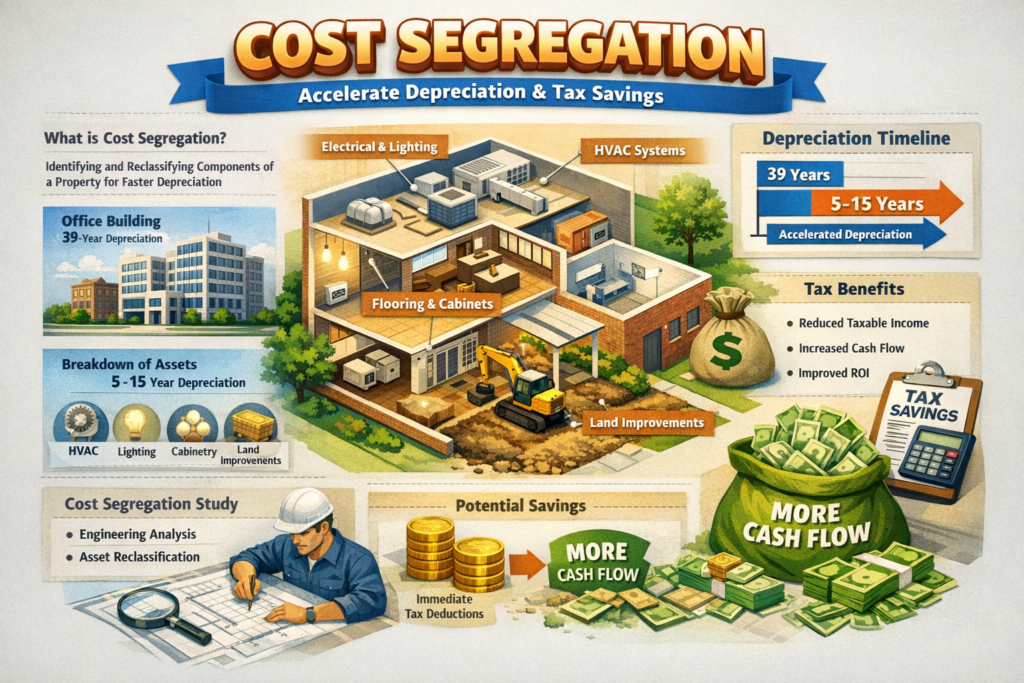
What Cost Segregation Is and Why It Exists
Cost Segregation is a method recognized under U.S. tax rules that separates a building into individual asset components for depreciation purposes. Instead of depreciating an entire property over a long recovery period, qualifying components may be assigned shorter depreciation lives when supported by proper analysis.
The purpose of Cost Segregation is not to eliminate tax, but to change the timing of depreciation deductions. By accelerating certain deductions to earlier years, taxpayers may improve cash flow while remaining within the boundaries of federal tax regulations.
Cost Segregation Eligibility and General Requirements
Cost Segregation does not automatically apply to every property. Eligibility depends on the nature and use of the property, as well as how it generates income.
Commonly recognized eligibility factors include:
- Property located in the United States
- Property used for income-producing or business purposes
- Commercial buildings, industrial facilities, and multi-family rental properties
- Newly acquired or previously placed-in-service properties, subject to applicable rules
Eligibility standards and interpretations may vary depending on tax year and regulatory updates. Property owners should confirm current criteria through official government guidance before proceeding.
How the Cost Segregation Process Works
Cost Segregation involves technical and tax analysis rather than a simple accounting election. A typical process includes:
- Review of property acquisition or construction records
- Detailed analysis of building components and systems
- Classification of assets under applicable depreciation categories
- Adjustment of depreciation schedules on tax filings
Proper documentation is essential, as depreciation classifications may be reviewed by tax authorities if examined.
Common Misunderstandings About Cost Segregation
Several misconceptions frequently arise regarding Cost Segregation:
- It does not guarantee tax savings for every property
- Smaller properties may experience limited benefits
- The method is permitted, but improper classification can create compliance issues
Cost Segregation should be evaluated as a technical tax strategy rather than a blanket solution.
Key Cost Segregation Information Overview
| Category | Details |
|---|---|
| Eligibility | Income-producing U.S. real estate |
| Amount | Depreciation impact varies by asset composition |
| Usage Type | Acceleration of depreciation deductions |
| Usage Period | Certain components may use shorter recovery periods |
| Important Notes | Rules may change based on tax law updates |
Frequently Asked Questions About Cost Segregation
Can Cost Segregation be used for personal residences?
Generally, properties used solely as personal residences do not qualify. The method typically applies to business or rental properties.
Is Cost Segregation available for properties already owned?
In some cases, existing properties may qualify, depending on when they were placed in service and applicable tax provisions for the year.
Does using Cost Segregation increase audit risk?
Using the method itself is not prohibited. However, insufficient documentation or unsupported classifications may raise compliance concerns.
How to Verify Cost Segregation Rules and Criteria
Because Cost Segregation is governed by federal tax law and official administrative guidance, readers are encouraged to independently verify current rules by:
- Reviewing depreciation rules issued by federal tax authorities
- Checking officially published guidance on asset classification and recovery periods
- Confirming any recent legislative or regulatory updates affecting depreciation
If criteria vary by year or policy revision, the most recent official announcements should be relied upon.
Practical Considerations When Using Cost Segregation
When evaluating Cost Segregation, property owners should consider property size, holding period, and long-term plans such as refinancing or sale. Because tax regulations evolve, it is advisable to re-confirm applicable standards before and after implementation. Additional foundational context can be found in the internal resource <a href=”/us-tax-basics”>U.S. Tax Fundamentals Overview</a>, along with further confirmation through official public institution publications.
This article is for informational purposes only. Consult a CPA for personalized advice.