Are you preparing to launch a business in the United States this year? Selecting the correct legal structure is the foundation of your future success. This guide provides a fact-checked analysis of The Entrepreneur’s Guide to Choosing Between LLC, S-Corp, and C-Corp in 2026, comparing tax benefits, liability protections, and operational requirements to help you make an informed decision aligned with current federal regulations.
Table of Contents
- Why Your Business Structure Choice Matters in 2026
- Key Differences: LLC vs. S-Corp vs. C-Corp
- Comparison Table: Business Structures at a Glance
- 5 Strategic Steps for Choosing the Right Structure
- Frequently Asked Questions (FAQ)
- How to Verify Information via Official Sources
- Final Steps for Your 2026 Business Launch
Why Your Business Structure Choice Matters in 2026
When starting a business in the U.S., selecting a legal entity is not merely a paperwork formality; it is a strategic decision that dictates your tax obligations, ability to raise capital, and the extent of your personal liability protection. In 2026, this decision is even more critical due to the strict enforcement of the Corporate Transparency Act, which requires most entities to report Beneficial Ownership Information (BOI) to FinCEN.
A hasty decision can lead to unnecessary double taxation or administrative penalties. Therefore, entrepreneurs must carefully evaluate their options based on the latest IRS and state-level regulations.
Key Differences: LLC vs. S-Corp vs. C-Corp
Each business structure has distinct eligibility requirements and operational advantages. The following information is based on general guidelines from the Internal Revenue Service (IRS) and the Small Business Administration (SBA).
1. Limited Liability Company (LLC)
The LLC is the most popular structure for small businesses due to its flexibility and simplicity.
- Eligibility & Features: There is no limit on the number of owners (members). Individuals, corporations, and other LLCs can be members.
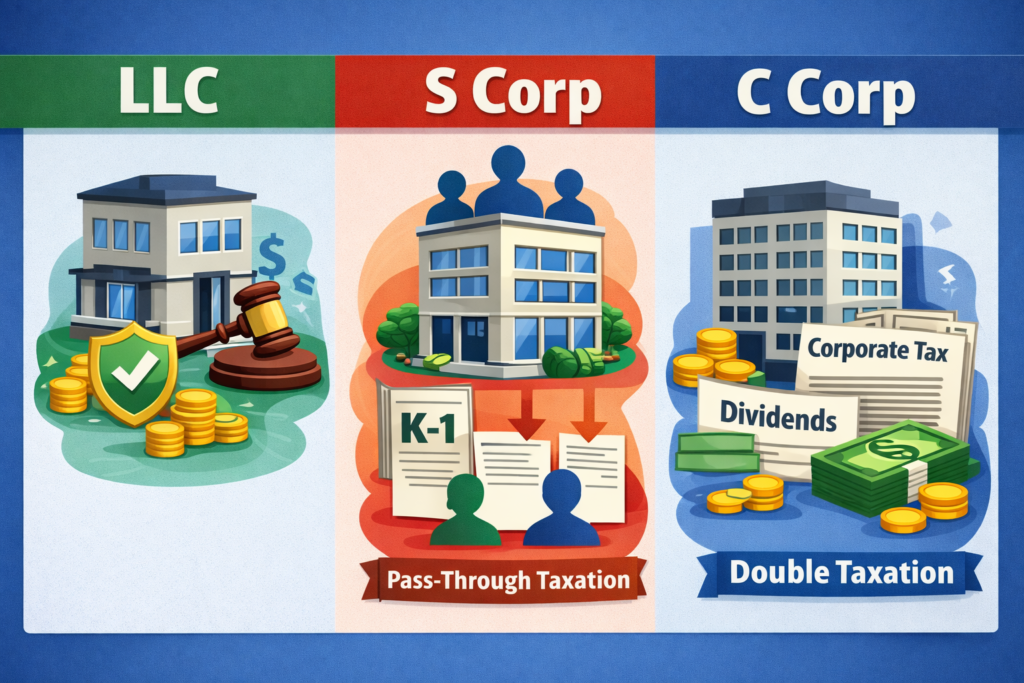
- Taxation: Default status is “Pass-through taxation.” The business itself does not pay income tax; instead, profits and losses pass through to the owners’ personal tax returns.
- Important Note: All profits are generally subject to Self-Employment Tax (Social Security and Medicare).
2. S Corporation (S-Corp)
An S-Corp is not a business entity type but a specific tax designation granted by the IRS.
- Eligibility Requirements:
- Must have no more than 100 shareholders.
- Shareholders must be U.S. citizens or Resident Aliens (Non-resident aliens cannot be shareholders).
- Must issue only one class of stock.
- Benefits: It avoids double taxation. Owners can be paid a “Reasonable Salary” (subject to employment taxes), while remaining profits distributed as dividends may be exempt from self-employment tax.
3. C Corporation (C-Corp)
This is the standard corporation structure and is considered a distinct legal entity separate from its owners.
- Features: There are no restrictions on the number or nationality of shareholders. It is the required structure for most venture capital (VC) investments.
- Taxation: It faces Double Taxation. The corporation pays corporate income tax on earnings, and shareholders pay personal income tax on dividends received.
- Purpose: Ideal for high-growth startups planning to go public (IPO) or seeking institutional funding.
[Internal Link: detailed guide on business registration documents]
Comparison Table: Business Structures at a Glance
The table below outlines the fundamental differences. Please note that state-specific filing fees and franchise taxes may vary.
| Category | LLC (Limited Liability Company) | S-Corp (S Corporation) | C-Corp (C Corporation) |
| Ownership Limits | No limit | Max 100 shareholders (US Citizens/Residents only) | No limit |
| Taxation Method | Pass-through (Personal Tax) | Pass-through (Personal Tax) | Double Taxation (Corporate + Dividend Tax) |
| Self-Employment Tax | Typically applies to all net earnings | Applies only to wages (Dividends exempt) | Not applicable (Taxed on salary/dividends) |
| Capital Fundraising | Difficult (Cannot issue stock) | Limited (Stock restrictions) | High (Can issue unlimited stock classes) |
| Operational Complexity | Low (Flexible management) | Medium (Strict payroll rules) | High (Requires board, bylaws, annual meetings) |
5 Strategic Steps for Choosing the Right Structure
Use this 5-step strategy to effectively navigate The Entrepreneur’s Guide to Choosing Between LLC, S-Corp, and C-Corp in 2026.
- Assess Capital Needs: If your roadmap includes seeking funding from Venture Capitalists or Angel Investors, a C-Corp is almost always required due to its preferred stock options.
- Verify Owner Citizenship: If you plan to have foreign investors or co-founders who are non-resident aliens, you are ineligible for an S-Corp. You must choose an LLC or C-Corp.
- Simulate Taxes & Profitability: If you anticipate losses in the first few years, an LLC allows you to deduct these losses against other personal income. If you expect high profits, an S-Corp election may save money on self-employment taxes.
- Evaluate Administrative Capacity: If you lack the resources to hold board meetings and keep detailed minutes, start with an LLC to minimize administrative burdens.
- Plan Your Exit Strategy: If your goal is an IPO or acquisition by a public company, starting as a C-Corp can save you from complex conversion costs later.
Frequently Asked Questions (FAQ)
Q1. Can I start as an LLC and switch to an S-Corp or C-Corp later?
Yes, this is a common strategy. An LLC can elect to be taxed as an S-Corp or C-Corp by filing specific forms (Form 2553 or Form 8832) with the IRS. However, converting the legal entity type itself involves state-level filings and can be complex, so professional guidance is recommended.
Q2. Can a single-person business become an S-Corp?
Yes. A single-member LLC can elect S-Corp status. However, the owner must be treated as an employee and pay themselves a “Reasonable Salary” according to IRS guidelines before taking distributions. Failure to do so can trigger audits.
Q3. What is the deadline for S-Corp election?
To be effective for the current tax year, you must file Form 2553 no later than two months and 15 days after the beginning of the tax year (usually March 15th for calendar-year businesses).
How to Verify Information via Official Sources
Business regulations can change annually. Do not rely solely on third-party blogs. You should independently verify all eligibility criteria and tax rates through the following official government channels:
- Eligibility & Forms: Visit the Internal Revenue Service (IRS) Official Website and search for “S Corp Eligibility” or “LLC Filing” to view the most current federal requirements.
- State Registration & Fees: Go to the official Secretary of State website for the state where you intend to operate. Search for “Fee Schedule” or “Annual Report Requirements” to confirm local costs.
- Support Programs: Visit the U.S. Small Business Administration (SBA) for official guides on business structures and government-backed funding opportunities.
Final Steps: Leveraging The Entrepreneur’s Guide to Choosing Between LLC, S-Corp, and C-Corp in 2026
Choosing the right entity is a pivotal moment for your business. Your decision should prioritize the factor most critical to your 2026 goals: tax efficiency, investment readiness, or operational simplicity.
We recommend reviewing the official sources linked above and consulting with a Certified Public Accountant (CPA) or a business attorney to finalize your choice. Taking these prudent steps now will establish a secure and compliant foundation for your company’s future growth.
This article is for informational purposes only. Consult a CPA for personalized advice.