
This article provides a professional Cash vs Accrual: A Comparative Analysis, detailing 5 essential reporting factors to ensure IRS compliance and financial transparency for modern businesses.
[Table contents]
- Conceptual Framework of Cash vs Accrual: A Comparative Analysis
- IRS Compliance and Revenue Threshold Requirements
- 5 Technical Differences in Recognition and Reporting
- Strategic Impact on Taxation and Liquidity
- Frequently Asked Questions (FAQ) for Business Owners
- Independent Verification of Regulatory Accounting Standards
- Optimizing Performance Through Cash vs Accrual: A Comparative Analysis
Conceptual Framework of Cash vs Accrual: A Comparative Analysis
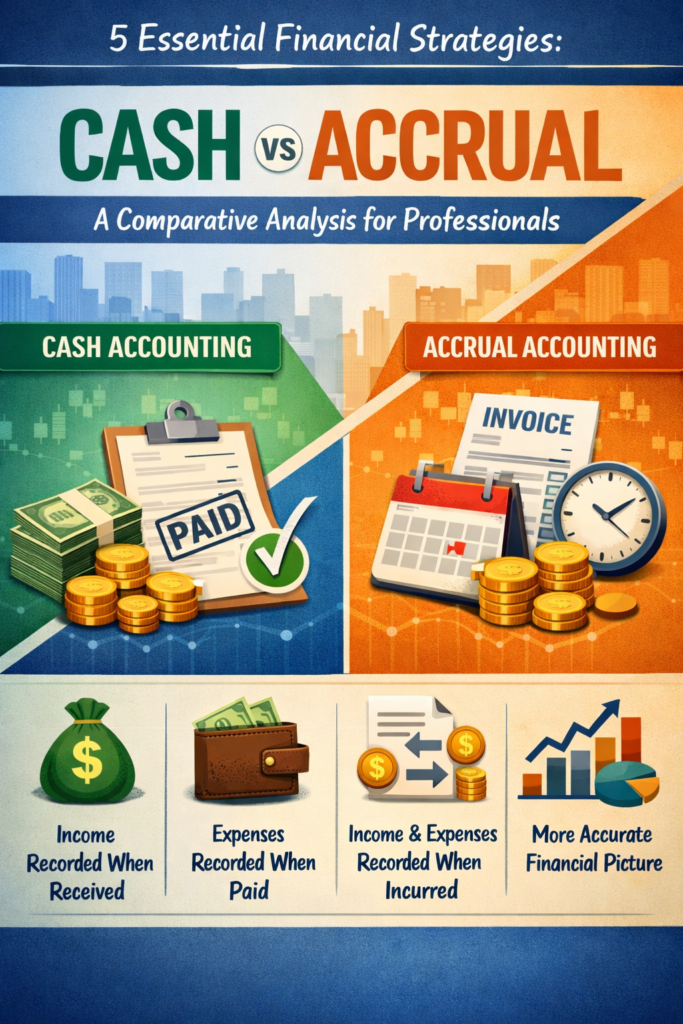
In the field of professional accounting, the selection of a reporting method is a foundational decision that dictates how a firm’s financial health is perceived by stakeholders and regulators. Cash vs Accrual: A Comparative Analysis demonstrates that while the cash method offers simplicity, the accrual method provides a sophisticated adherence to the “Matching Principle.”
The cash method recognizes transactions only when currency is exchanged. This is often preferred by sole proprietorships for its intuitive nature. Conversely, the accrual method—mandated by Generally Accepted Accounting Principles (GAAP) for larger entities—recognizes revenue when it is “earned” and expenses when they are “incurred.” This distinction is critical for maintaining an accurate audit trail and ensuring that financial statements reflect the actual economic activity of the reporting period.
IRS Compliance and Revenue Threshold Requirements
The Internal Revenue Service (IRS) provides strict guidelines under the Internal Revenue Code (IRC) regarding which entities are eligible for specific accounting methods. Failure to comply with these thresholds can result in mandatory adjustments and potential penalties during an audit.
- Gross Receipts Test: Under current federal regulations, small business taxpayers are generally defined as those with average annual gross receipts for the prior three-year period not exceeding a specific indexed threshold (approximately $30 million for recent tax years, though this may vary depending on the year or policy updates).
- Inventory Considerations: Entities that maintain significant inventory were traditionally required to use the accrual method. However, current provisions allow certain qualifying small businesses to use the cash method even if they have inventory, provided they meet specific simplified accounting criteria.
- Tax Shelter Restrictions: It is important to note that “tax shelters” are strictly prohibited from utilizing the cash method of accounting, regardless of their gross receipts or business size.
Business owners must verify their eligibility annually, as exceeding the revenue threshold for three consecutive years may trigger a mandatory change in accounting method via IRS Form 3115.
5 Technical Differences in Recognition and Reporting
1. Timing of Revenue Recognition
In Cash vs Accrual: A Comparative Analysis, the primary differentiator is the “triggering event.” The cash method recognizes income upon receipt of payment, whereas the accrual method recognizes income the moment a service is completed or a product is delivered, creating an “Accounts Receivable” entry.
2. Matching Principle Application
Accrual accounting utilizes the matching principle, ensuring that expenses are recorded in the same period as the revenue they helped generate. The cash method does not follow this principle, which can result in distorted profit margins during months with high capital expenditures.
3. Visibility of Liabilities
The accrual method provides a comprehensive view of future obligations through “Accounts Payable.” This allows for a more accurate assessment of long-term solvency. The cash method provides no visibility into outstanding debts until the moment of payment.
4. Complexity of Bookkeeping
From a CPA perspective, the accrual method requires significantly more rigorous record-keeping, including year-end adjustments for prepaid expenses and unearned revenue. The cash method is less labor-intensive but lacks the depth required for complex financial analysis.
5. Influence on Net Income
Due to the timing of recognition, net income can fluctuate wildly between the two methods for the same fiscal period. High-growth companies often appear more profitable on a cash basis if they delay paying vendors, whereas the accrual method would reflect those unpaid obligations immediately.
Strategic Impact on Taxation and Liquidity
| Category | Cash Method | Accrual Method |
| Eligibility | Generally $< $30M Gross Receipts | Mandatory for Corporations/Large Entities |
| Tax Planning | High flexibility via payment timing | Low flexibility; tied to economic events |
| Audit Risk | Lower for small entities | Standard for mid-to-large entities |
| Reporting Accuracy | Focuses on Liquidity | Focuses on Profitability |
| Implementation | Cost-effective and simple | Resource-intensive but GAAP compliant |
Selecting the appropriate method requires an analysis of current cash flow versus long-term growth objectives. While the cash method may provide temporary tax deferral benefits, the accrual method is typically required for securing institutional financing or preparing for an exit strategy. For further details, refer to our Corporate Tax Strategy Guide.
Frequently Asked Questions (FAQ) for Business Owners
Can a business switch accounting methods mid-year?
Typically, a change in accounting method is considered a change in accounting principle and requires IRS consent. This is usually handled by filing Form 3115 during the tax year for which the change is requested.
Which method is better for a service-based business?
Many service-based professionals prefer the cash method because it prevents them from paying taxes on income they have not yet physically received from clients. However, if the business seeks to go public or sell, the accrual method is often a prerequisite.
How does the accrual method affect my bank balance?
The accrual method does not track your actual bank balance. It is possible for a business to show a significant profit on an accrual basis while simultaneously experiencing a cash flow crisis due to uncollected receivables.
Independent Verification of Regulatory Accounting Standards
Accounting standards and IRS thresholds are subject to periodic adjustments based on legislative updates and inflation. It is the responsibility of the taxpayer to ensure continued compliance. You can verify the latest rules by:
- Accessing official government tax websites and searching for “Publication 538, Accounting Periods and Methods.”
- Reviewing the “Gross Receipts Test” updates for the current fiscal year to confirm your business’s eligibility for simplified reporting.
- Consulting official announcements regarding Section 448 of the Internal Revenue Code for specific prohibitions on method usage.
- Please confirm the latest criteria through official announcements or by consulting with a licensed CPA in your jurisdiction.
Optimizing Performance Through Cash vs Accrual: A Comparative Analysis
Mastering Cash vs Accrual: A Comparative Analysis is a prerequisite for any business aiming for financial maturity. While the simplicity of cash-based reporting is attractive for startups, the transition to accrual-based reporting is a milestone that signals institutional readiness and sophisticated financial management.
Businesses should conduct a “shadow” accrual analysis even if they report on a cash basis to truly understand their operational efficiency. By tracking receivables and payables, management can identify bottlenecks in the collections process that cash-basis reporting would otherwise obscure. We recommend reviewing your revenue trends against IRS thresholds quarterly to ensure you are prepared for any mandatory reporting transitions. Prioritizing these standards ensures your entity remains in good standing with both regulatory bodies and potential investors.
This article is for informational purposes only. Consult a licensed CPA or accounting professional for personalized advice.